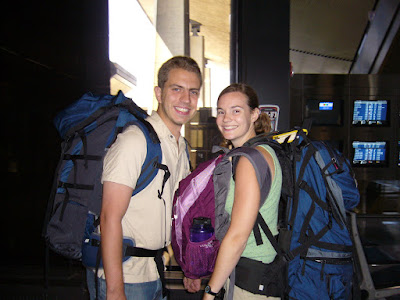
We have 6 months to explore the Western Hemisphere, and this blog will chronicle our journey. It will (hopefully) include Hanford Bay, Niagra Falls, Groton, Boston, San Francisco, Santa Barbara, San Diego, Argentina, Bolivia, Peru, Ecuador, Chile, and Brazil!
Our friend, Elena, is planning a big trip to Bolivia and Peru. Dan and I have been emailing her advice, but I thought our advice might be useful to other travelers out there, so why not post it online? As a warning, this probably won't be very interesting to people who aren't planning a trip to Bolivia or Peru, so read at your own will.
Hotel in La Paz We stayed at Hotel Gloria ( Potosí 909) in La Paz. This was after a 4 day Salt flat jeep tour where we had extremely rustic conditions, so we were looking to "splurge" in La Paz, and hence we stayed there for about $60 per night, which is a lot for Bolivia. It has hot water, and even heat in the room during the evening. It was fine, but it was definitely a hotel, rather than a hostel type environment.
Bus from La Paz to Copacabana We took a "local" bus to Copacabana, which was much cheaper than a tourist bus. I think a tourism package would actually pick you up at the hotel and take you there, making it really easy, but a local bus is cheap and an experience if you are interested in that. We had a taxi take us to the bus station for buses headed for Copacabana (it is somewhere different from the main bus station, but people at hotels / hostels would know). Immediately, someone was rushing us onto their bus that was leaving soon. The key thing to know for the ride is that they make you get off the bus and take a boat across some water, and you leave your bags on the bus while the bus floats across the water on a separate vessel (shown below). We were scared of doing this, but it worked out fine. Make sure you have your passport though. Another plus with the local instead of tourist bus is that all the tourist buses leave extremely early in the morning and I'm pretty sure the local buses leave throughout the day. The local bus isn't exactly comfortable, but since it's such a short ride, it's worth it for the adventure. Plus, the price difference is something like $2 vs $20.
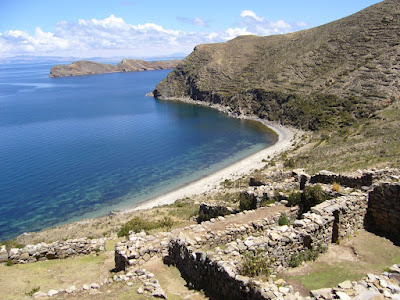
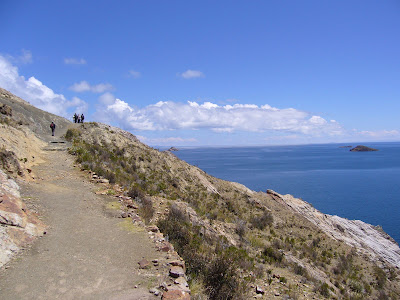
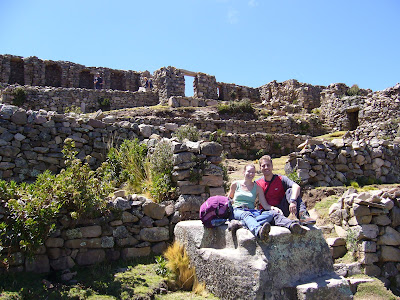
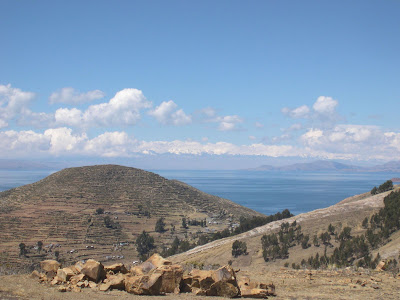
Isla del Sol If you're not totally comfortable with Spanish, I'd recommend hiring an English guide for touring Isla del Sol. Once again, the price difference is something like $2 for Spanish and $20 for English, but our guide had a lot of neat stories about the island that made it much more interesting. We did Isla del Sol all in one day, which is a lot of hiking but good practice for the Inca Trail. I also remember that the early morning boat ride to Isla del Sol was really cold and I was glad to have all my removable layers (hat, gloves, fleece, windbreaker, and pants). You can buy nice and warm llama wool stuff most anywhere in the Andes, but I think we saw some of the best prices in La Paz.
Lake Titicaca, Peru For the Peru side of Lake Titicaca, we did a one day tour of the floating islands and one other island. We did not stay overnight with locals, which some people said they loved but others said was too touristy or was awkward staying with people they didn't know. Although pretty touristy, I thought the floating islands were really neat. I could have skipped going to the second island because it was a really long boat ride to get there and I thought Isla del Sol was similar but better.
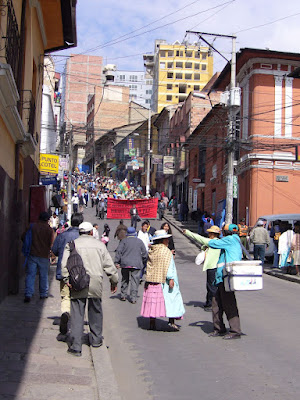
Pisac, Peru While in Cusco, I highly recommend going to Pisac, which is a nearby town. There is a market there that had some of the best shopping of our entire trip, but it might not be every day of the week. It also had the 2nd best ruins I saw on the trip (Machu Picchu was #1, of course). The ruins are on on the top of a mountain next to town. Even if you hire a taxi to take you to the top, be sure to wear proper hiking clothes and bring water because it's no easy stroll. Also, be sure to bring enough money for everything because there are no ATMs in Pisac. To get to Pisac from Cusco we took a taxi to a tiny little bus station on the edge of town. Then a local bus to Pisac, which costs less than a dollar, but be sure to have small change with you. In fact, always try to have tons of small change with you because people in Bolivia and Peru really dislike making change. For food, there is a really good empanada place in one of the corners of the market. From where the bus and taxis drop off, you have to walk about a block up a street/alley to get to the market (shown below). The first section of the market you'll encounter is the produce area. If you are walking up the street towards the market, take a left as soon as you get to the produce area. Tucked away in the corner is a little courtyard with an outdoor brick oven. It's right near a hiking gear store. They also sell roasted Guinea pig there, but I'm not into that.
Cusco Sights If you're going to see more than one of the ruins in and around Cusco, you should get a multiple day pass, which I think you can buy at any of the sites. They're a little expensive by Peru standards, so make sure you have enough cash with you for the first ruins you go to.
Security Try to avoid having much cash on you (or at least disperse it) when you pass from Bolivia to Peru because I've heard of a scam where they claim your money is counterfeit. Also, always have your passport in a money belt or in a safe deposit box, never in a bag. Try to get a receipt for what you put in your safe deposit box and avoid putting cash in safe deposit boxes. Also, while on non-tourist buses, never let your carry-on bags out of touch. You may even want to safety pin some of the zippers shut because I've heard a few stories of people reaching under seats (I think someone tried to do this to me in Ecuador, but my safety pins stopped them). I've never heard of problems with large bags stowed under the bus, except for them getting dirty. When we flew from the US, United gave us giant plastic bags for our hiking backpacks which we continued using whenever we checked our bags (I think most big airlines have these, but you sometimes have to ask for them). Not only did the plastic keep our bags clean, but I also thought they provided an extra layer of security just because it made it more of a pain to steal anything.
This post comes to you from Quito, Ecuador. Carrie and I got here on Saturday, and we've been resting up for our upcoming trip to the jungle. While we haven't done much exploring here in Quito yet, we've had a good time just going to nearby restaurants and bars... Fortunately (or perhaps unfortunately), we were able to catch the Cubs game at Wrigley Field, and watched them get swept away by the Diamondbacks. On a happier note for me, I was able to find a bar with NFL Sunday Ticket, and watched the Patriots game, followed by switching bars to watch the Red Sox dominate the Angels. Hopefully, the Yankees will fall soon, but we'll see... Anyways, the last narrative post I did went up to Lake Titicaca on the Bolivian side. From there, we entered Peru...
We took a "tourist" bus from Copacabana, Bolivia to Puno, Peru, on the other side of Lake Titicaca. While on that bus, we spoke with one of the employees who decided to befriend us and help us find a hotel. As always, we were initially skeptical of people who tried to arbitrarily sell us things. However, this man (whose name was Palermo) offered a free taxi ride and a good rate, and showed us the hotel's location, which appeared to be decent. We took Palermo up on his offer, and we ended up in a reasonable hotel for only 50 soles (about 16 dollars) per night, which appeared to be a substantial discount off of their posted rates.
From there, Palermo was ready to offer us tours of the Peruvian islands of Lake Titicaca, and book us on a special guided tourist bus to Cusco that made stops to tour several locations along the way. While we managed to find a better deal for the island tours, we did take Palermo up on his bus offer. He even insisted that he call one of his friends in Cusco who would help us find a good price for a hotel. More on that later...
After spending some time in Puno, we realized that Peru was a much more touristy country than Bolivia. There were districts of Puno filled with tourists walking the streets, and English speaking Peruvians hassling you to enter their restaurant or buy their products. On our Peruvian islands of Lake Titicaca tour, we had a boat full of 25 tourists, which was quite different from our private tour on the Bolivian side!
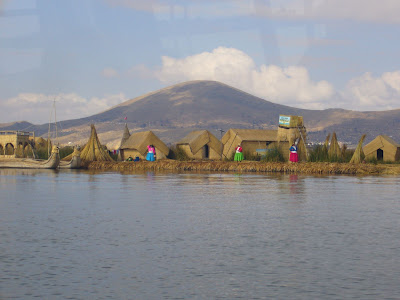
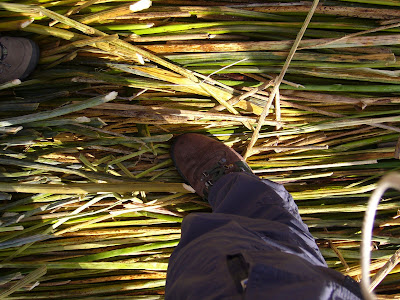
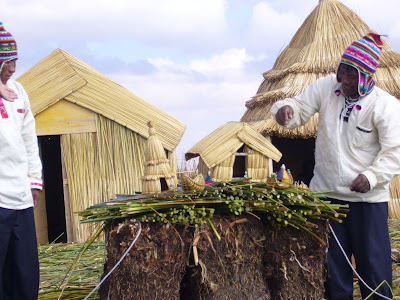
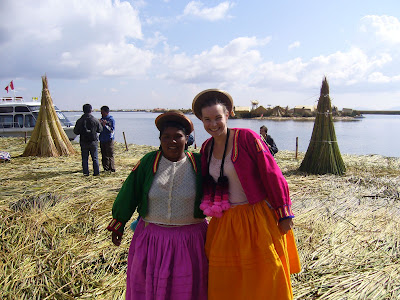
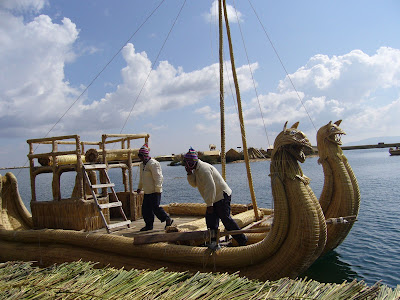
The first stop on our island tour was to the Uros floating islands, which were quite amazing, although it was clearly very touristy. The islands were apparently constructed using reeds, and we watched a demonstration explaining how the islands were secured to the lake. A woman showed us her home, which featured solar powered electricity! There was some doubt amongst our tour group if the locals actually lived on this island, or if they actually lived on the mainland and came to the islands to put on a show for the tourists. My guess was that they actually lived there, but their way of life consisted mostly of tourism shows, and not the fishing and craft-making lifestyle that they talked about. Here are some pictures:
One of the floating islands (viewed from our boat):
After the floating islands, our boat headed for the Taquile island. Here, we hiked for a few hours, but honestly didn't see too much stuff worth remembering, in my opinion. The boat ride took a couple hours to get to this island from the floating islands, and it took another 3 hours to get back to the mainland. My recommendation for future Peruvian travelers would be to focus on the Uros islands and skip the Taquile.
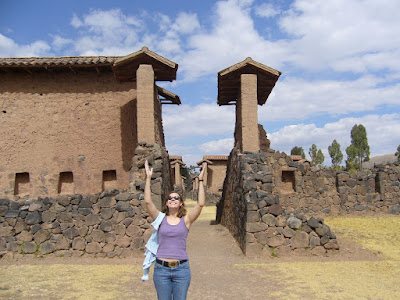
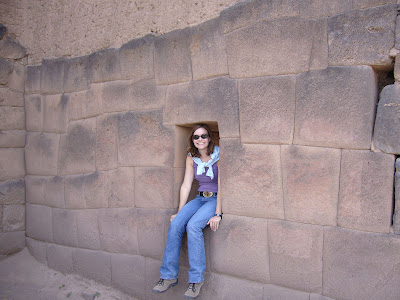
After our island tour, we got ready to head to Cusco. The bus ride was fairly uneventful -- we observed some sights on the way, but the "touristy" feel was a little overwhelming. There were clearly people waiting for us at each sight, ready to sell us anything and everything. Our favorite sight along the way was an Incan temple... the stonework was pretty incredible. Here are a couple pictures:
Once the bus arrived in Cusco, we were immediately mobbed by people telling us we should have them find us a hotel. One person gave a name that sounded familiar... I think it was the name Palermo gave us back in Puno. We decided to see what this guy had to offer. He ended up finding us a nice hotel where we enjoyed a comfortable 2 story room in a good location for only $25 per night!
Cusco was a nice town -- a good mix of tourists and locals, with lots of restaurants, bars, and sights. With our time in Cusco before our Inca trail tour, we visited the town of Pisac and their incredible market (Carrie has a post about that), as well as various museums around town that came with the Cusco "tourist pass", a fairly expensive (and possibly overpriced) ticket that got you into most sights around Cusco. As expected, Carrie became an expert at bargaining for free drinks and appetizers at restaurants.
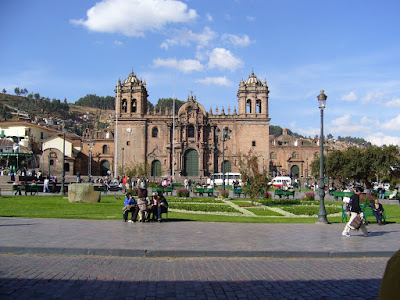
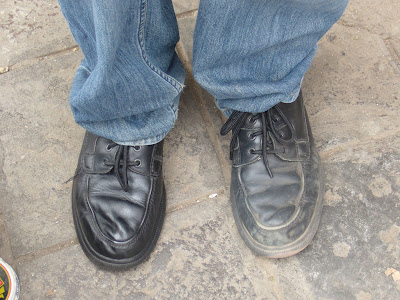
One good story from Cusco involves me and my dirty shoes. As Carrie and I walked through the Plaza de Armas, a fairly young boy offerred to shine my shoes. Looking at my shoes, it looked like I actually needed it. We asked him for his price, and he said "whatever you want, maybe 3 soles ($1)". I told him I'd give him 2 soles. He began shining my shoes, and after abount 1 minute, a police officer approached, scolding the kid and telling him he couldn't do that where we were. So we moved to a different street away from the plaza. The kid them resumed, and actually was doing a nice job (see this picture at the halfway point):
This was when things got interesting... The kid began telling me that one cleaner he was using was "very special", and cost extra. Since he was doing a good job, I had planned on paying him a little extra anyways, so I didn't really object. Then, ANOTHER police officer came, yelled at the kid, and told us we should only pay him 1 sole (abour $0.30). After the police officer left, the kid told us that since he was using the "special cleaner", we needed to pay him TEN SOLES ($3.33), to which we laughed and told him we'd give him 5 (what we had been planning to give him). He shook his head, saying that was no good, but he finished the job, and we gave him 5 soles, and left. He appeared unhappy, but we felt he was going to look unhappy unless he successfully rippped us off, so we felt fine about the whole thing.
OK -- let's get to the big stuff... The Inka Trail and Machu Picchu:
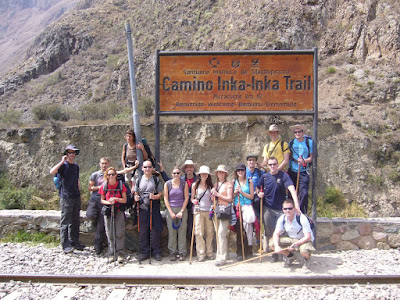
Last spring, we reserved our trek with Peru Treks, an organization that appeared to be highly recommended by some books and websites. Generally speaking, they did not disappoint. Our group consisted of 15 hikers, 2 cooks, 2 guides, and 20 porters to carry all of the equipment. There were 4 days of hiking, 3 nights spent in tents along the way. On the last day, we arrived at Machu Picchu, where we explored for most of the day before heading back to Cusco on the train.
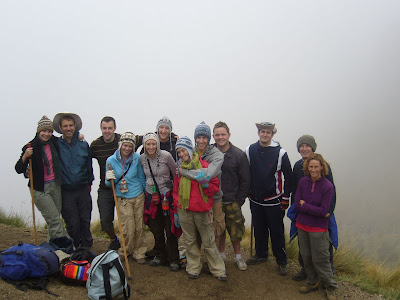
Our tour group consisted of 8 friends (all about 24 years old and aspiring accountants) from Ireland, 3 friends from Scotland, 2 friends from England, and Carrie and I. Our group was very friendly, and it was nice for Carrie and I that everyone spoke English, so we didn't feel left out of any conversations. Unfortunately, by the end of the trek, our group was in rough shape, as everyone but 2 of the trekkers got sick during the trip, and one trekker through his back out and had to be carried to Machu Picchu on a stretcher!
As for the crew from Peru Treks, they were exceptional. Our guides, Victor and Puma, were both knowledgeable about the area, and were also good at managing the different speeds of the hikers. Carrie and I felt that they allowed us enough freedom to hike on our own, while still being fully in control and aware of what was going on. Our two cooks made surprisingly gourmet meals throughout the trip. Each day, we got a full breakfast, a snack for the hike, a 3-4 course lunch, another 3-4 course dinner, and tea after every meal! There are some decent food pictures in the photo album, which you can get to by clicking here.
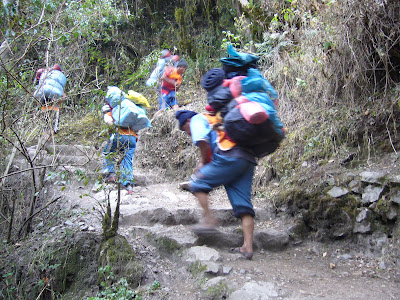
I need to dedicate a separate paragraph for the porters. Some porters carried food and cooking equipment, others carried tents and camping gear, and others carried luggage for the trekkers. Trekkers had the option to rent a duffel bag, which they could fill with 6kg worth of gear to be carried by a porter. Once you filled the bag, a porter carried your bag, and the bags of 2 OTHER PEOPLE. All porters carried up to 20kg worth of gear at one time. Here's the incredible part... On a typical day, we'd be woken up, and breakfast would be ready in 30 minutes. After breakfast, the guides and trekkers would start out on the trail. Midway through the trek, we'd here running behind us, and porters would RACE PAST US with 20kg worth of gear!
Once we got to our location for lunch, the dining and cooking areas were already completely set up, food was being prepared, and the porters were CLAPPING FOR US for bravely hiking the trail with our tiny day packs! After lunch, we would start hiking, the porters could clean up, then race past us, and by the time we got to our campsite, the tents, dining areas, and cooking areas were already set up, and the porters were clapping again! It was really incredible.
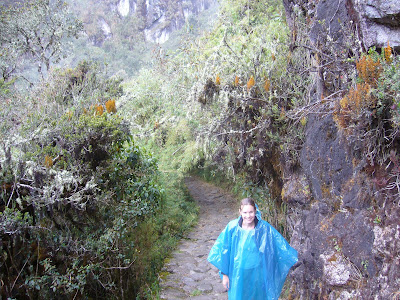
As for the trek itself, it was HARD. Day 1 was the "easy day", where we hiked in fairly flat elevations. Carrie and I, trying to keep ourselves in the best shape as possible, took it easy on the first night. We quickly realized we had a fun group of trekkers when the rest of our group immediately started drinking beers upon arriving at the campsite! They managed to completely clean out the supply held by the woman living at the campsite! Here is a video of Carrie at our first campsite:
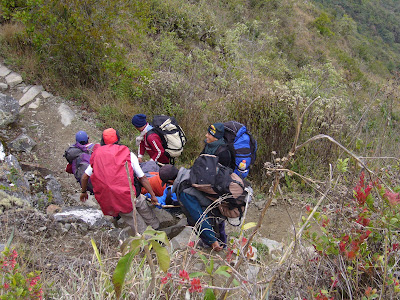
Day 2 was when things started getting really tough. Most of the day was uphill, and very steep. In addition, some of our fellow trekkers began falling ill with some sort of nasty stomach flu. The uphill sections were extremely tough -- Carrie and I would take 20 steps, rest, take 20 more steps, rest, and repeat. Finally, we reached the highest point on the Inka Trail:
After the summit, we headed downhill for another couple hours. While we welcomed not having to climb anymore, the downhill was hard because of its steepness. I tweaked my ankle a bit after landing on some steps badly, and my knees began to ache from the constant downhill. Finally, we arrived at our campsite, where we rested up.
Day 3 was not much easier, unfortunately. It was the longest distance hiking day, featuring both uphills and downhills. In addition, new group memebers were becoming sick. Probably the only good things about this day were the tropical scenery and the fact that there were shower facilities at the 3rd campsite.
Unfortunately, I became the newest victim of the stomach bug during the 3rd night. I won't get into details, but I'll say that it was a long and unpleasant night. To make matters worse, we needed to wake up at 3:45 am!
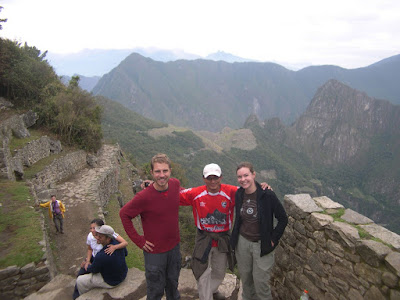
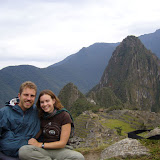
For day 4, we had the rude awakening in darkness. I was unable to really eat much breakfast, and we started out on the hike to Machu Picchu. I moved slowly, step by step, gradually built up an appetite, and was eventually able to eat some snacks. I was not alone in my difficulties -- another girl got sick as well, and our trekker with the bad back was now unable to walk. Miraculously, we eventually made it to the Sun Gate, where we got our first glimpse of Machu Picchu. In this photo, Carrie and I are with our assistant guide, Puma. You can see Machu Picchu in the distant background:
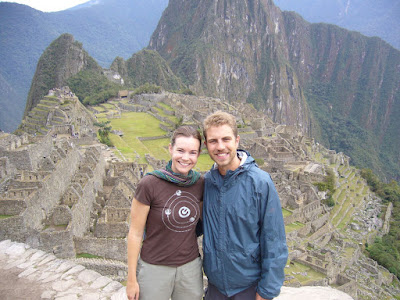
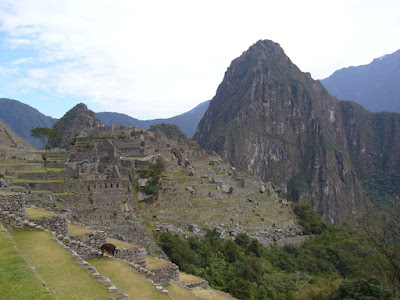
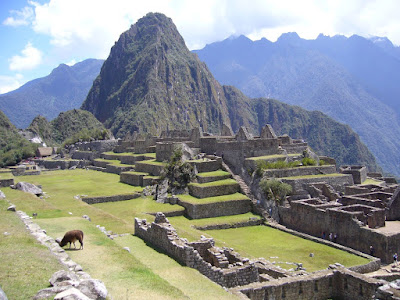
After the Sun Gate, we headed downhill to Machu Picchu itself. It truly is a remarkable place, having been constructed many hundreds of years ago! What was hard was that so many people (myself included) were really exhausted by the time we actually got there. While our head tour guide gave us the Machu Picchu tour, I found myself walking to each point, listening to the first minute of his talk, and then involuntarily dosing off. Luckily, Carrie had a bit more energy and was able to absorb more of the information. Below are a couple of my favorite pictures, but I'd highly encourage everyone to view the full photo album... we put captions in for many of the pictures.
Generally speaking, while I thought the tour company was great, I'm not sure I'd recommend the full 4 day trek. It is very grueling, unless you are a seasoned trekker in great shape who really loves this kind of thing. By the time we got to the best part, we were exhausted. Instead, I'd recommend just taking the train from Cusco to the Machu Picchu city of Aguas Calientes, where you can then take a short bus to the ruins.
OK!! Enough for now... Look for a new post maybe in about a week regarding our Ecuadorian adventures!
Carrie and I are in Cusco, Peru, having just gotten back from our 4 day Inka Trail trek to Machu Picchu. That was quite the experience -- something that will require a separate post... We have the photo album uploaded if you can't wait (click on the Machu Picchu photo below), and here's a movie from that trek to wet your appetite...
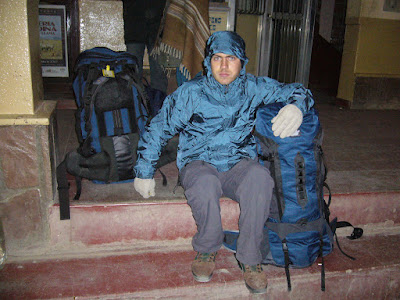
Before the trek, there were plenty of adventures worth writing about. After horseback riding in Salta, Argentina, we got ready to head for Bolivia. We found an overnight bus from Salta to La Quiaca, the border town with Bolivia. We had heard that Argentinian buses were good, but this bus was rather unfortunate. To start, the person in front of me reclined virtually into my lap. After that, the heat came on, and it REALLY came on. It was extremely uncomfortable. I practically had to hug the window pane, in order to absorb some of the cold air outside. When we finally arrived, I was quickly cooled off by the FRIGID temperatures outside! The sun hadn't yet come up, and since the border hadn't opened yet, we had to wait outside for about 45 minutes! Needless to say, I wasn't enjoying myself so much...
After crossing the border, we found the bus area, where we were immediately approached by several people trying to convince us to board their bus. One woman was mentioning Tupiza (our destination), but we were initially skeptical of people approaching us, so we said no and headed to the "terminal" area. We eventually realized that the people approaching you were actually the main way to get on buses, so we boarded this woman's bus. After talking to other people before our trip, we were worried that we'd be sitting on the floor of a school bus with chickens, but on this bus we actually had fairly comfortable seats. The bus flew through the streets, honking its horn relentlessly. We quickly learned that Bolivia does not specialize in paved roads, and the ride was rather bumpy. What was amusing was that the bus would randomly stop seemingly in the middle of nowhere and pick people up or drop them off. One French tourist fell asleep for the ride, and when he woke up, his bag was missing from the rack above him. Luckily for Carrie and I, our bags were in the storage area underneath the bus, and they were still there at the end of the ride.
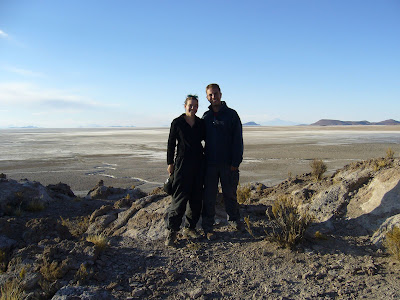
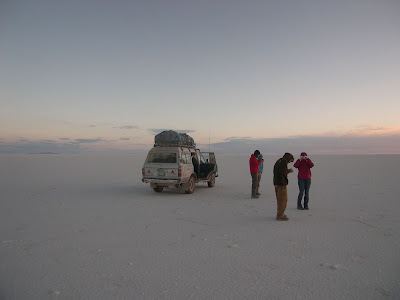
Tupiza, much like other Bolivian tourist towns, was small, cute, and very touristy. There were small markets, a few internet cafes, some hostels, and lots of "Italian" restaurants selling pizza and pasta. Apparently this is the default tourist food. From here, we began our search for a tour company to take us on the 4 day jeep tour to the Salar de Uyuni. This was somewhat stressful, because we were speaking in broken Spanish or broken English with people explaining routes, options, the potential for English speaking guides. To add to the stress, the cost was dependent on how many people were in the group, and since it was just Carrie and I, we were relying on other people wanting to go on the same tour. We finally settled on a company, and ended up with a group of 5 tourists, one guide, and one cook. Carrie's 5,000 meters post has a photo of our entire group.
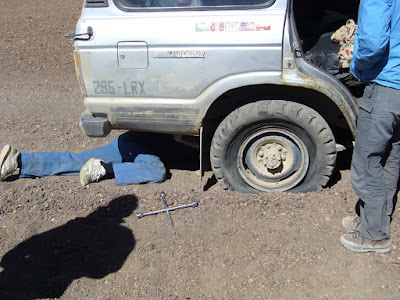
Our guide was named Rubén, and he was an outstanding driver who managed to navigate road conditions that were brutal at times.
Our chef was named Augustina, who was very friendly and cooked quite good meals! The other tourists included a French couple, and a Colorado College student taking a semester off. We were all packed into a Toyota Land Cruiser, with our backpacks thrown on top of the jeep, along with other supplies. After spending a few hours on the road, we were thankful that our group was not the maximum size of 6 tourists, which would have required 3 people in both the middle AND back rows. The weather was frigidly cold at night, so when we left in the morning, we eagerly waited for the moment that the sun would rise high enough to reach the jeep. As for the altitude, we found that sitting in a jeep was a good way to get used to things, because it didn't require any physical exertion. Chewing coca leaves also helped.
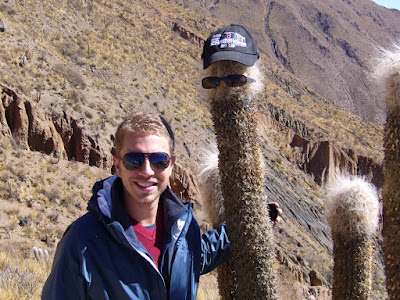
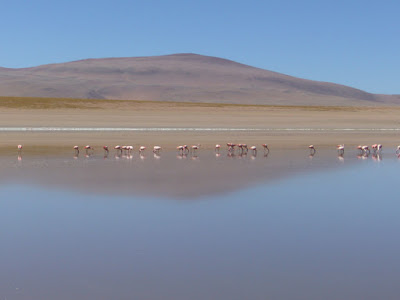
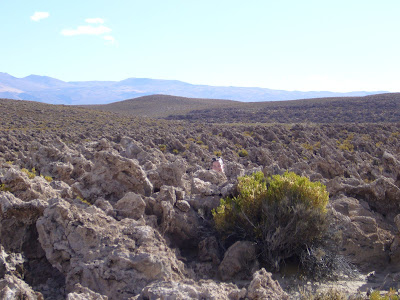
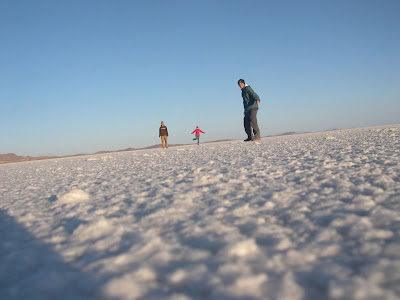
There were many times on this tour that I thought I was on another planet. There were no real roads to speak of, and the landscapes were like nothing I had ever seen before. We might drive for hours in fairly barren desert, and suddenly we'd approach a picturesque lake with flamingos! Below are some of my favorite photos and movies from the jeep tour:
After the Jeep Tour, we took an overnight bus to La Paz, the capital. The bus was once again very bumpy, but the temperatures were more comfortable, and we actually managed to sleep! The city was very crowded, but it was nice to have fairly modern amenities. We went to some interesting museums, one of which was the coca museum. Bolivians and Peruvians have very interesting opinions about the coca leaf. Basically, the coca leaf has been used in its natural form by people of the Andes for hundreds and hundreds of years without problems. It is helpful for altitude, digestion, and energy. The problems came when outsiders came and figured out how to make the concentrated form of cocaine.
After La Paz, we rode a public bus to Copacabana, on Lake Titicaca. The highlight of the public bus was randomly being told to get off the bus and board a boat, while leaving our bags on the bus. While we were initially very skeptical, we later saw our bus floating on a boat next to us, and felt better. Copacabana is a cute small town, and has a church which "blesses" cars that come to it. In fact, our jeep from the Salar tour had been blessed there! From here we took a boat to the Isla del Sol, where we had an English speaking guide take Carrie and I on a tour. Here are some pictures:
After Isla del Sol, we took a bus to Puno, Peru, on the other side of the lake. Since this post has gotten rather long, I'll wait and write about our Peruvian adventures in my next post. ¡Hasta luego!