Showing posts with label bolivia. Show all posts

Wednesday, March 5, 2008

Bolivia and Peru Advice

Our friend, Elena, is planning a big trip to Bolivia and Peru. Dan and I have been emailing her advice, but I thought our advice might be useful to other travelers out there, so why not post it online? As a warning, this probably won't be very interesting to people who aren't planning a trip to Bolivia or Peru, so read at your own will.

Hotel in La Paz
We stayed at Hotel Gloria ( Potosí 909) in La Paz. This was after a 4 day Salt flat jeep tour where we had extremely rustic conditions, so we were looking to "splurge" in La Paz, and hence we stayed there for about $60 per night, which is a lot for Bolivia. It has hot water, and even heat in the room during the evening. It was fine, but it was definitely a hotel, rather than a hostel type environment.
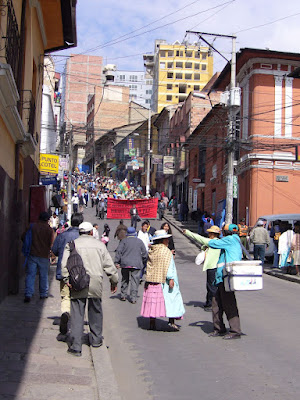

From La Paz


Bus from La Paz to Copacabana
We took a "local" bus to Copacabana, which was much cheaper than a tourist bus. I think a tourism package would actually pick you up at the hotel and take you there, making it really easy, but a local bus is cheap and an experience if you are interested in that. We had a taxi take us to the bus station for buses headed for Copacabana (it is somewhere different from the main bus station, but people at hotels / hostels would know). Immediately, someone was rushing us onto their bus that was leaving soon. The key thing to know for the ride is that they make you get off the bus and take a boat across some water, and you leave your bags on the bus while the bus floats across the water on a separate vessel (shown below). We were scared of doing this, but it worked out fine. Make sure you have your passport though. Another plus with the local instead of tourist bus is that all the tourist buses leave extremely early in the morning and I'm pretty sure the local buses leave throughout the day. The local bus isn't exactly comfortable, but since it's such a short ride, it's worth it for the adventure. Plus, the price difference is something like $2 vs $20.


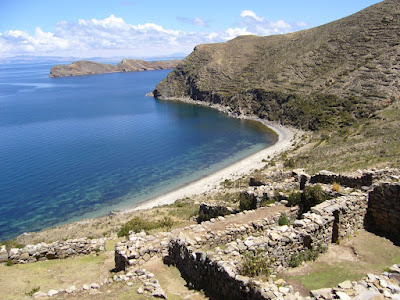
From Lake Titicaca


Isla del Sol
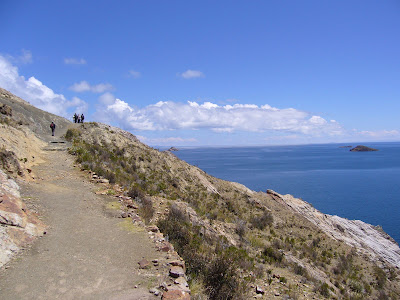
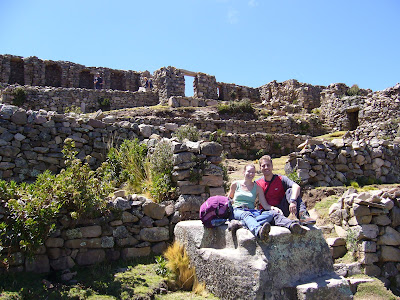
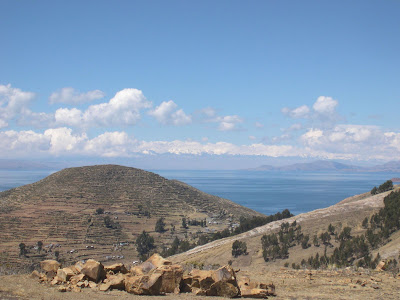
If you're not totally comfortable with Spanish, I'd recommend hiring an English guide for touring Isla del Sol. Once again, the price difference is something like $2 for Spanish and $20 for English, but our guide had a lot of neat stories about the island that made it much more interesting. We did Isla del Sol all in one day, which is a lot of hiking but good practice for the Inca Trail. I also remember that the early morning boat ride to Isla del Sol was really cold and I was glad to have all my removable layers (hat, gloves, fleece, windbreaker, and pants). You can buy nice and warm llama wool stuff most anywhere in the Andes, but I think we saw some of the best prices in La Paz.

From Lake Titicaca


Lake Titicaca, Peru
For the Peru side of Lake Titicaca, we did a one day tour of the floating islands and one other island. We did not stay overnight with locals, which some people said they loved but others said was too touristy or was awkward staying with people they didn't know. Although pretty touristy, I thought the floating islands were really neat. I could have skipped going to the second island because it was a really long boat ride to get there and I thought Isla del Sol was similar but better.


From Lake Titicaca


Pisac, Peru
While in Cusco, I highly recommend going to Pisac, which is a nearby town. There is a market there that had some of the best shopping of our entire trip, but it might not be every day of the week. It also had the 2nd best ruins I saw on the trip (Machu Picchu was #1, of course). The ruins are on on the top of a mountain next to town. Even if you hire a taxi to take you to the top, be sure to wear proper hiking clothes and bring water because it's no easy stroll. Also, be sure to bring enough money for everything because there are no ATMs in Pisac. To get to Pisac from Cusco we took a taxi to a tiny little bus station on the edge of town. Then a local bus to Pisac, which costs less than a dollar, but be sure to have small change with you. In fact, always try to have tons of small change with you because people in Bolivia and Peru really dislike making change. For food, there is a really good empanada place in one of the corners of the market. From where the bus and taxis drop off, you have to walk about a block up a street/alley to get to the market (shown below). The first section of the market you'll encounter is the produce area. If you are walking up the street towards the market, take a left as soon as you get to the produce area. Tucked away in the corner is a little courtyard with an outdoor brick oven. It's right near a hiking gear store. They also sell roasted Guinea pig there, but I'm not into that.


From Cusco, Peru


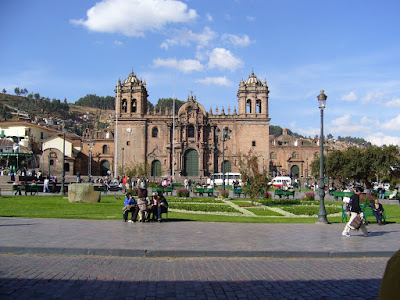
Cusco Sights
If you're going to see more than one of the ruins in and around Cusco, you should get a multiple day pass, which I think you can buy at any of the sites. They're a little expensive by Peru standards, so make sure you have enough cash with you for the first ruins you go to.

From Cusco, Peru


Security
Try to avoid having much cash on you (or at least disperse it) when you pass from Bolivia to Peru because I've heard of a scam where they claim your money is counterfeit. Also, always have your passport in a money belt or in a safe deposit box, never in a bag. Try to get a receipt for what you put in your safe deposit box and avoid putting cash in safe deposit boxes. Also, while on non-tourist buses, never let your carry-on bags out of touch. You may even want to safety pin some of the zippers shut because I've heard a few stories of people reaching under seats (I think someone tried to do this to me in Ecuador, but my safety pins stopped them). I've never heard of problems with large bags stowed under the bus, except for them getting dirty. When we flew from the US, United gave us giant plastic bags for our hiking backpacks which we continued using whenever we checked our bags (I think most big airlines have these, but you sometimes have to ask for them). Not only did the plastic keep our bags clean, but I also thought they provided an extra layer of security just because it made it more of a pain to steal anything.

From Argentina Part 1

Wednesday, January 23, 2008

Closing the book

Hello everybody! I am writing this from our new apartment in Oakland, California. I don't have many photos yet, but I do have one picture of us with our new car, the Honda Fit!


Before we get to engrossed in our new lives in California, I wanted to do a final recap of South America. For one, the trip lasted a long time -- 3.5 months of traveling. It was long enough that I really got used to the lifestyle. Speaking Spanish became second nature. I became used to meeting Europeans, Australians, and Canadians on a regular basis, and rarely met Americans traveling. Dissecting menus became a daily ritual, as did evaluating rooms at hostels, hosterias, posadas, and hotels. Our most important possessions were our passports, ATM cards, cameras, and photo backup CDs.

Do I miss South America? Let me count the ways:
- I miss the excitement of entering a town or city for the first time, and taking everything in as I step off of the bus.
- I miss the family owned bed and breakfast lodging, where the owners would go out of their way to make sure we were comfortable and enjoying ourselves.
- I miss sipping Caipirinhas while listening to a mix of ocean waves and live samba played by street musicians.
- I miss the landscapes of Bolivia.
- I miss Argentine steakhouses.
- I miss the awe-inspiring history of Peru.
- I miss the diversity and friendliness of Ecuador.
- I miss the music and energy of Brazil.
- I miss the wildlife of the Galapagos.

What am I glad to have back? There's a list for that too:
- I'm glad to have friends and family in the same country again.
- I'm glad to have American music back. Especially jazz.
- I'm glad to have English be the primary language again.
- I'm glad to have a phone.
- I'm glad to have the internet be reliable and helpful again.
- I'm glad to be able to turn on sports television and not have soccer be the only option.
- I'm glad to know where I'll be sleeping each night.
- I'm glad to be able to eat home cooked meals.

What were my favorite countries?
  1. Brazil -- The people are incredibly friendly and laid back, the weather is warm, the beaches are beautiful, the music is fantastic, and the food is delicious!
  2. Ecuador -- There is just so much to see and do in Ecuador, and it's incredibly easy to do it all because the country is so small! The people are friendly, the fresh fruits are great, and everything is cheap to boot!
  3. Argentina -- You can view glaciers, beautiful lakes and snow-capped mountains, tour wine country, ride horseback through ranches, and explore one of the largest and most sophisticated cities in the world. Oh yeah, and I love the steak!
  4. Bolivia -- If you don't mind roughing it a bit, you'll be handsomely rewarded by landscapes that are literally out of this world. It's also the cheapest country we visited. Now, if they could only get heat and hot water figured out.
  5. Peru -- Machu Picchu is incredible, as is much of the scenery here. For seafood, you can't do much better than ceviche in Lima. I just had a hard time with the "touristy" feel here, and the constant harassment from people hoping to sell me something.
What are the specific destinations that I would recommend most?
  • Salar de Uyuni, Bolivia. I truly felt like I was on another planet during this 4 day jeep tour. The landscapes were absolutely incredible, and like nothing I have seen before or after. I also loved the feeling of being completely isolated in the absolute middle of nowhere. If you can put up with very basic accommodations and long days sitting in a jeep riding on bumpy unpaved roads, this is one of the most incredible things you can do in South America.
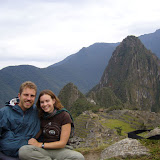
  • Machu Picchu. Maybe skip the 4 day hike beforehand, but do not skip Machu Picchu. The ruins are truly awe-inspiring, and it deserves its status as one of the wonders of the world.
  • Galapagos Islands. If you love wildlife, this is one of the greatest destinations you can visit. Unfortunately, the costs to visit are high and will only get higher.
  • El Calafate, Argentina. The glaciers are phenomenal, it stays light out until 11pm during the summer, the town is cute, and it's Argentina, so you'll eat well.
  • Iguazu Falls. If you love waterfalls (or even if you don't), you'll be amazed by what you see and hear.
  • Ilha Grande, Brazil. The beaches are fantastic, there are no cars, and it's Brazil, so you'll definitely eat well and have incredibly friendly hospitality.
  • Banos, Ecaudor. You can do tons of different adventure activities during the day, then come back and relax in one of the many hot baths in town. The whole town is beautiful, and its Ecuador, so you won't be spending much.
All in all, I'm really glad we took the trip. Before we left, people told us it would be an experience of a lifetime, and it didn't disappoint. I'm also glad we did things on our own, and didn't just go on a long tour. Even though we suffered through some of the logistical planning, we got to become immersed in the countries and had the freedom to do whatever we wanted. It would have been nice to have a travel agent helping us out, but the Lonely Planet goes a long way. Now that we're done, I'll always be able to look back at our photos and this journal, and know that we did it. Thanks to everyone who wrote to us during the trip, offering words of encouragement or feedback on this blog.

In the future, I hope to write one last post about the logistics of traveling, in hopes that fellow tourists who stumble upon this blog will be able to use our experiences to better their own travels. I want to thank everyone again for reading!

Wednesday, November 28, 2007

Fing BsAs

They finally did it. They tried to do it while we were walking down the streets of La Paz, Bolivia, and again while riding a bus from Quito, Ecuador, but they finally succeeded while at the bus terminal in Buenos Aires. I always keep the important pockets of my backpack safety pinned shut. This proved especially essential on the bus from Quito because even though I was sitting with the bag on the floor between my legs, the guy behind me still managed to reach under the seat and open my bag as far as the safety pin would let him. He was gone before I knew what had happened, but got nothing.

Unfortunately, safety pins don´t do much good when they steal the whole bag. We make a point to always keep our passports and most money in our pants. The guy who stole our backpack didn´t get anything of value, or at least of much value to him. When you´re traveling for 3.5 months and each carrying only about 35 lbs of stuff, everything is valuable. The stolen backpack had the following:

- Dan´s jacket
- Bottle of nice wine from Mendoza
- Half of our toiletries (toothbrushes, toothpaste, floss, shampoo, soap, shaving cream, Dan´s deodorant, Dan´s razor, sunscreen, and laundry soap)
- All of our travel books

The other small backpack, that was fortunately not stolen, contained much more, including the better of our two cameras, backup photo CDs, and my medicine. Basically, stuff that is much harder, if even possible, to replace. But it still sucks.

When I realized what happened my hands got all tingly and I thought I might faint, but I ended up just screaming a bunch. Dan remained fairly rational and ran around looking for the bag. We seriously considered finding a way to fly home right then, but that would almost definitely have resulted in staying at least one more night in Buenos Aires. Being in BsAs without a hotel reservation can be very stressful even under good circumstances, so instead we decided to continue with the original plan and take a 20 hour bus ride to Bariloche.

The ride would have been great if our windows weren´t painted over and our speakers actually worked so we could hear the movies (2 of the 3 were English w/ Spanish subtitles, the other Spanish w/ English subtitles), but at least we had the super fancy seats that reclined to be totally flat and we slept fairly well for at least 6 of the 20 hours (it would have been more if I wasn´t so stressed from the robbery). I wouldn´t mind taking another one of those fancy buses for another 20 hours, as long as I didn´t have to go anywhere near the BsAs bus terminal. Maybe from Iguazu to Rio.

We´ll probably survive with just having to buy a new travel guide for Brazil, probably something to keep Dan warm in El Calafate, and of course, the essential toiletries. Definitely Dan´s deodorant, but I doubt he´ll replace the razor.

Sunday, September 23, 2007

Update from Cusco, Peru

Hello!

Carrie and I are in Cusco, Peru, having just gotten back from our 4 day Inka Trail trek to Machu Picchu. That was quite the experience -- something that will require a separate post... We have the photo album uploaded if you can't wait (click on the Machu Picchu photo below), and here's a movie from that trek to wet your appetite...


Inka Trail - Machu Picchu


Before the trek, there were plenty of adventures worth writing about. After horseback riding in Salta, Argentina, we got ready to head for Bolivia. We found an overnight bus from Salta to La Quiaca, the border town with Bolivia. We had heard that Argentinian buses were good, but this bus was rather unfortunate. To start, the person in front of me reclined virtually into my lap. After that, the heat came on, and it REALLY came on. It was extremely uncomfortable. I practically had to hug the window pane, in order to absorb some of the cold air outside. When we finally arrived, I was quickly cooled off by the FRIGID temperatures outside! The sun hadn't yet come up, and since the border hadn't opened yet, we had to wait outside for about 45 minutes! Needless to say, I wasn't enjoying myself so much...


After crossing the border, we found the bus area, where we were immediately approached by several people trying to convince us to board their bus. One woman was mentioning Tupiza (our destination), but we were initially skeptical of people approaching us, so we said no and headed to the "terminal" area. We eventually realized that the people approaching you were actually the main way to get on buses, so we boarded this woman's bus. After talking to other people before our trip, we were worried that we'd be sitting on the floor of a school bus with chickens, but on this bus we actually had fairly comfortable seats. The bus flew through the streets, honking its horn relentlessly. We quickly learned that Bolivia does not specialize in paved roads, and the ride was rather bumpy. What was amusing was that the bus would randomly stop seemingly in the middle of nowhere and pick people up or drop them off. One French tourist fell asleep for the ride, and when he woke up, his bag was missing from the rack above him. Luckily for Carrie and I, our bags were in the storage area underneath the bus, and they were still there at the end of the ride.

Tupiza, much like other Bolivian tourist towns, was small, cute, and very touristy. There were small markets, a few internet cafes, some hostels, and lots of "Italian" restaurants selling pizza and pasta. Apparently this is the default tourist food. From here, we began our search for a tour company to take us on the 4 day jeep tour to the Salar de Uyuni. This was somewhat stressful, because we were speaking in broken Spanish or broken English with people explaining routes, options, the potential for English speaking guides. To add to the stress, the cost was dependent on how many people were in the group, and since it was just Carrie and I, we were relying on other people wanting to go on the same tour. We finally settled on a company, and ended up with a group of 5 tourists, one guide, and one cook. Carrie's 5,000 meters post has a photo of our entire group.

Our guide was named Rubén, and he was an outstanding driver who managed to navigate road conditions that were brutal at times.


Our chef was named Augustina, who was very friendly and cooked quite good meals! The other tourists included a French couple, and a Colorado College student taking a semester off. We were all packed into a Toyota Land Cruiser, with our backpacks thrown on top of the jeep, along with other supplies. After spending a few hours on the road, we were thankful that our group was not the maximum size of 6 tourists, which would have required 3 people in both the middle AND back rows. The weather was frigidly cold at night, so when we left in the morning, we eagerly waited for the moment that the sun would rise high enough to reach the jeep. As for the altitude, we found that sitting in a jeep was a good way to get used to things, because it didn't require any physical exertion. Chewing coca leaves also helped.

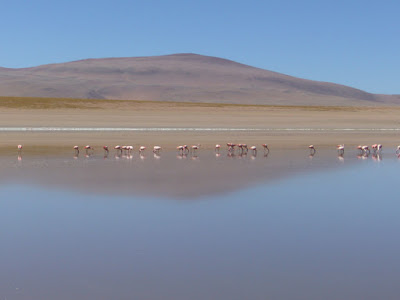
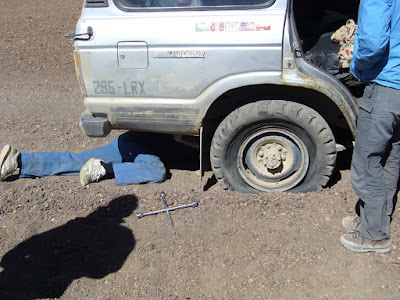
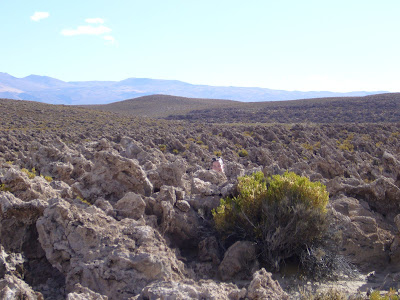
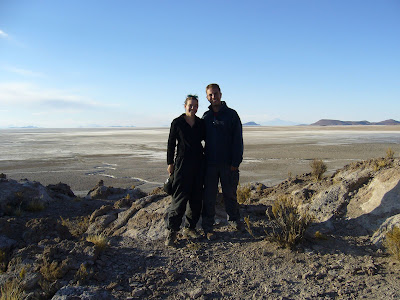
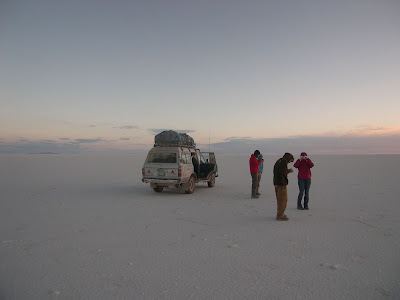
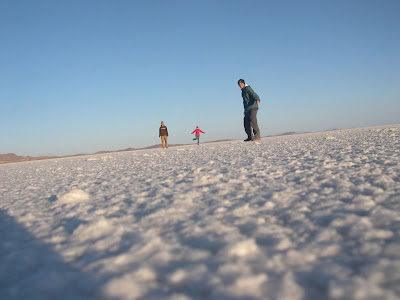
There were many times on this tour that I thought I was on another planet. There were no real roads to speak of, and the landscapes were like nothing I had ever seen before. We might drive for hours in fairly barren desert, and suddenly we'd approach a picturesque lake with flamingos! Below are some of my favorite photos and movies from the jeep tour:


From Salar de Uyun...


From Salar de Uyun...


From Salar de Uyun...


From Salar de Uyun...


From Salar de Uyun...


From Salar de Uyun...


From Salar de Uyun...


After the Jeep Tour, we took an overnight bus to La Paz, the capital. The bus was once again very bumpy, but the temperatures were more comfortable, and we actually managed to sleep! The city was very crowded, but it was nice to have fairly modern amenities. We went to some interesting museums, one of which was the coca museum. Bolivians and Peruvians have very interesting opinions about the coca leaf. Basically, the coca leaf has been used in its natural form by people of the Andes for hundreds and hundreds of years without problems. It is helpful for altitude, digestion, and energy. The problems came when outsiders came and figured out how to make the concentrated form of cocaine.

After La Paz, we rode a public bus to Copacabana, on Lake Titicaca. The highlight of the public bus was randomly being told to get off the bus and board a boat, while leaving our bags on the bus. While we were initially very skeptical, we later saw our bus floating on a boat next to us, and felt better. Copacabana is a cute small town, and has a church which "blesses" cars that come to it. In fact, our jeep from the Salar tour had been blessed there! From here we took a boat to the Isla del Sol, where we had an English speaking guide take Carrie and I on a tour. Here are some pictures:


From Lake Titicaca


From Lake Titicaca


From Lake Titicaca


After Isla del Sol, we took a bus to Puno, Peru, on the other side of the lake. Since this post has gotten rather long, I'll wait and write about our Peruvian adventures in my next post. ¡Hasta luego!