Unlike Brazil, we were always amazed by how trim Argentines were, despite their enormous meat portions. We suspected it had something to do with less driving and more walking, or possibly all that red wine. However, probably because of their amazing and abundant food, Brazil tended to have the heaviest people of all of the countries we visited in South America. That said, Brazil was also one of the friendliest countries we visited.
Brazil definitely has a wide variety of fruit, many of which I had never previously heard of. Cashew nuts are pretty common, but I learned that cashew trees also produce a fruit, referred to as caju in Portuguese. I never saw fresh caju fruit but the juice is very common in Brazil. The first time I had it I thought I was drinking watered down lemonade made from a powder. After learning what it was, I tasted it more closely and noticed a very subtle nutty flavor, but although not bad, I wouldn't say it's one of my favorite juices.
Guaraná is a very popular soda in Brazil. It is named after the guaraná berries it is flavored with, and is very sweet and carbonated. In addition, it is often cheaper than bottled water!
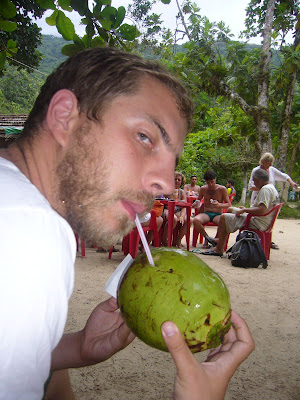
One of my favorite things to drink while in Brazil was coconut milk straight from the coconut! They would simply cut a hole in the top and stick a straw in. The milk has a gently sweet and coconutty flavor. I think it tastes more watery than milky and it is extremely refreshing. One of the best parts is that after you finish drinking, you can break it open and have a little snack. However, I tried to break one open using only a rock and it took forever (I guess I'm no survivor-lady). The second time around I went to a juice bar and they cracked it open for me.
 |
| From Ilha Grande, ... |
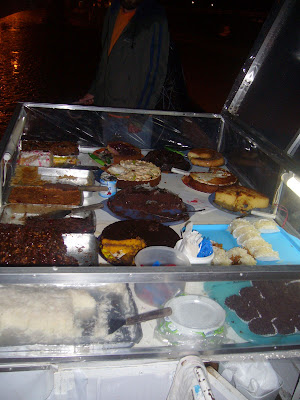
There are always ample opportunities for snacking while in Brazil. Almost every commercial corner in Brazil had at least one snack or juice bar. In addition, all along the sidewalks lining Ipanema and Copacabana beaches are snack stands. As if that wasn't enough, on the actual beaches there are dozens of vendors walking around selling beverages, açai smoothies, and even skewers of unshelled shrimp (these vendors sell much more than just food including sunglasses, purses, lime crushers, and even bikinis)! Even Praia Lopez Mendes, the remote beach on Ilha Grande that we had to hike to, had people selling sodas and sandwiches! Also on Ilha Grande, there were guys biking around enormous dessert carts. Below is a picture of one of those dessert carts:
 |
| From Ilha Grande, ... |
Through our travels, we noticed that every country has a totally different type of empanada. Argentina's empanadas were the most similar to what I've had in the US. In Brazil, the empanadas looked like tiny little chicken pot pies, about the diameter of a can of soda. The crust is also similar to a flaky pie crust, and they are usually filled with chicken or cheese.
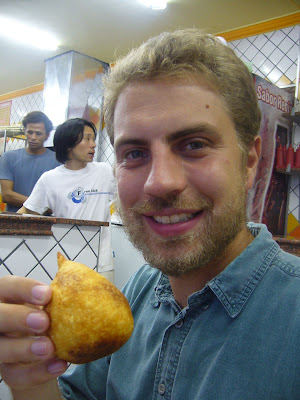
In addition to empanadas, Brazil has a wide variety of fried goodies to snack on. One of my favorites was like a fried, breaded hamburger. They kind of reminded me of my Mom's piroshkis (of course my Mom's were better). Dan's favorite was a teardrop shaped fried thing filled with chicken and cream cheese. Below is a picture of Dan eating on of those. However, according to our guide book, Brazilians never pick up their food with their bare hands, and often eat sandwiches with a knife and fork. Please excuse Dan's faux pas in the below shot:
 |
| From Ilha Grande, ... |
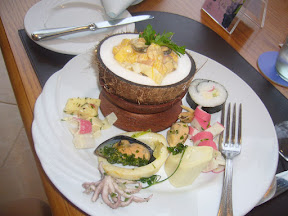
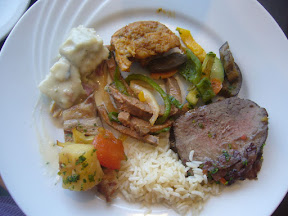
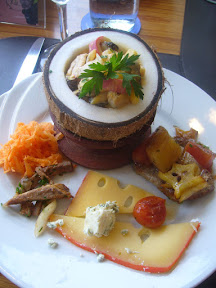
A very common dining option in Brazil are pay by weight buffets. As opposed to the all you can eat buffets in the US, I liked how these buffets don't encourage gorging. However, pay-by-weight buffets require a totally different eating strategy than all-you-can-eat buffets. I consider myself somewhat of an expert all-you-can-eat diner. While on the Argentine side of the Iguazu Falls, we splurged and went to the Sheraton's lunch buffet. It cost about $30 per person, which at the time was our most expensive meal of the trip (Brazil's stronger currency resulted in much more expensive meals). Below is a picture of each plate of food I had at the Sheraton buffet:
1st course: Appetizers
 |
| From Iguazu Falls |
2nd course: Main dishes
 |
| From Iguazu Falls |
3rd course: Best of appetizers and main dishes
 |
| From Iguazu Falls |
4th course: Gazpacho
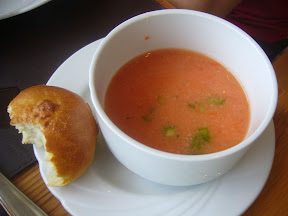 |
| From Iguazu Falls |
5th course: Dessert
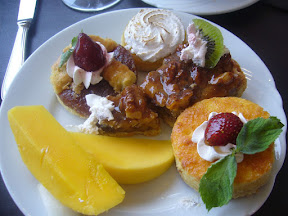 |
| From Iguazu Falls |
However, at pay-by-weight buffets, it's all about the quality of food, not the quantity. Rice, pasta, and beans tend to be heavy yet less expensive, so they should be avoided. Meat is a much better alternative. Many pay-by-weight buffets had sushi and shell fish, but I skipped that at some of the less fancy buffets. Another thing to avoid at pay-by-weight buffets is leaving any food behind. However, Dan and I were new to Brazilian cuisine, and we weren't always sure what we were going to like. At our first pay-by-weight buffet we first got little portions of everything we wanted to try. Later we went back and got larger portions of the things we liked. However, I don't think this is standard practice in Brazil because the woman who weighed our plates seemed to find us very amusing.
Brazil is also known for their all you can eat steak houses, called churrascarias. The first churrascaria we went to, called Porcão, was almost exactly like Fogo de Chão. In addition to an amazing buffet, they also have gaúchos walking around with big skewers of meat. Each person is given a little circular card that is green on one side and red on the other, and turning the card to the green side indicates to the gaúchos that you want more meat. Each gaúcho specially prepares the meat that they are serving, and it all looks so good that it is difficult to turn them down. I call the green/red card the meat faucet, because if you leave it on too long you will inevitably end up with a plate piled high with meat. The biggest difference I noticed between Brazilian and US churrascarias is that Brazilian churrascarias serve corazóns, or chicken hearts. Each one is about the size of a large kidney bean and the gaúchos carry enormous skewers of them. Unless you stop them, they'll give you a plate full! Personally, I really like corazóns, but only in moderation.
Our last night in Rio we tried to go to a seafood churrascaria, called Marius. Half of the restaurant is a regular meat serving churrascaria and the other half serves seafood, including lobster tails! However, we were shocked to learn that the seafood side cost about $80 per person not including drinks, so we decided to settle for the regular meat side. However, apparently everyone else thought the seafood was too expensive as well because the meat side was totally packed and the seafood side was fairly empty. The Maitre 'D told us it would be a 10 minute wait. The restaurant is covered in cutesy nautical themed decorations, which is a little annoying when you're really hungry. 40 minutes later they finally seated us, but they put us in the upstairs area of the seafood side. They assured us that we would still get good service, but I had my doubts since we were so far from the meat kitchen. We decided to leave, hopped in a cab, and asked him to take us to a good churrascaria. He took us to this little place just around the corner from the Copacabana Palace. It had a live pianist who was playing pretty cheesy music, but the food was delicious and it was a perfect end to our trip.